How to get cited by DeepSeek
Every guide names a DeepSeek user agent. We went looking for the documentation behind it and could not find any. Here is what you can actually verify.
How to get cited by DeepSeek
- How to get cited by DeepSeek
- Does DeepSeek have a crawler user agent?
- Why do DeepSeek SEO guides disagree with each other?
- How do I identify an undocumented crawler?
- Does DeepSeek read JavaScript-rendered pages?
- How should I structure a page when the vendor documents nothing?
- What should I not do about DeepSeek?
- What should I actually do about DeepSeek?
- How to get cited by DeepSeek: the short version
Search for how to control DeepSeek's crawler and you will find confident instructions naming a user agent called DeepSeekBot, usually with a robots.txt snippet to copy. We went looking for the primary source behind those instructions and could not find one.
That absence is the most useful thing we can tell you.
How to get cited by DeepSeek
To get cited by DeepSeek, serve your answers in server-rendered HTML, answer each question in its opening paragraph, and publish figures no other page carries. There is no DeepSeek robots.txt token to allow, because DeepSeek publishes no crawler user agent that could be verified at its own documentation.
There is no robots.txt group to write here, which is the honest version of the answer and the reason this post exists. What you can do instead is make sure your pages work for a fetcher that announces nothing and runs no JavaScript.
Terminal
curl -s https://yoursite.com/your-page | grep -i "the sentence that answers the question"If that returns nothing, the answer is being assembled by a script, and a plain fetcher will receive an empty shell.
That single command settles the most common failure, and it is a failure that looks exactly like a ranking problem while having nothing to do with ranking. With a documented crawler you could look up whether it executes JavaScript. With an undocumented one you cannot, so the page that needs nothing is the only safe page.
The other thing worth doing is quarterly rather than today:
- Read your raw access logs, not an analytics dashboard. Analytics filters bots out, and bots are the population you are trying to see.
- Group the requests by user agent and look at the strings with no marketing site behind them.
- Resolve the addresses. Reverse DNS and the network operator tell you more than a user agent string, which anyone can forge.
- Subtract the vendors who do publish lists. What is left is the genuinely unaccounted for, and now you can decide about it deliberately.
If you then want some of that traffic gone, block it at the network edge by IP or ASN and check the logs again. A robots.txt rule addressed to a name no vendor publishes or uses has no effect on anything.
Does DeepSeek have a crawler user agent?
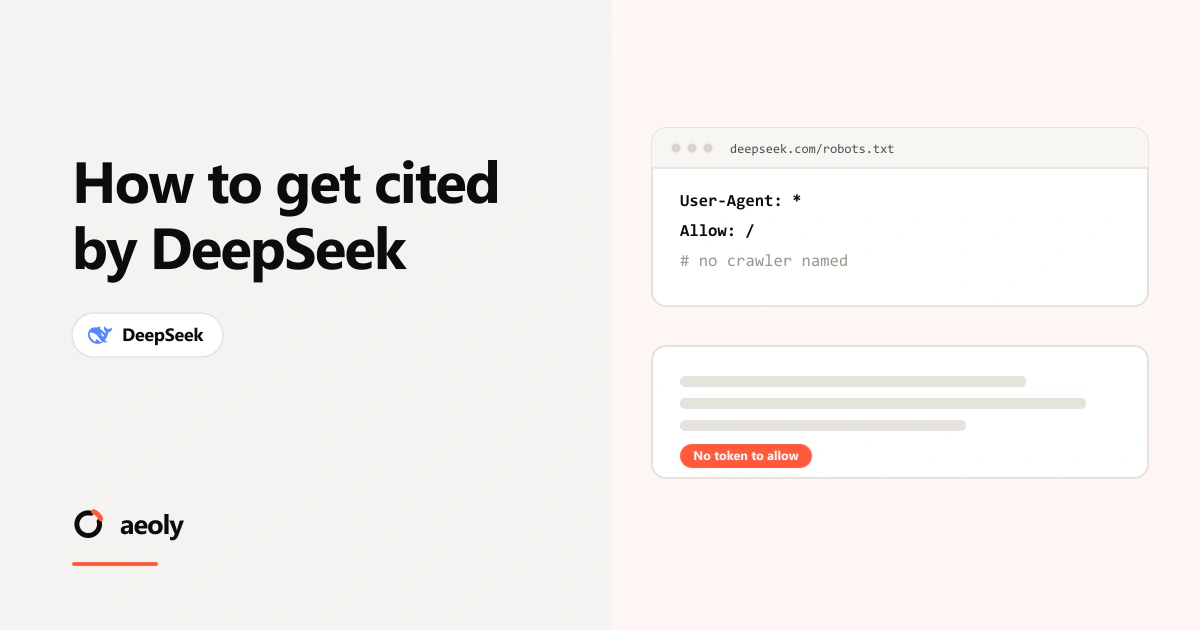
DeepSeek publishes no crawler documentation comparable to OpenAI's, Anthropic's or Perplexity's. Its own robots.txt at deepseek.com contains a single group allowing all user agents, names no bot of its own, and lists a sitemap. Its published API documentation covers models and integrations rather than web crawling. No official user-agent token could be verified at source.
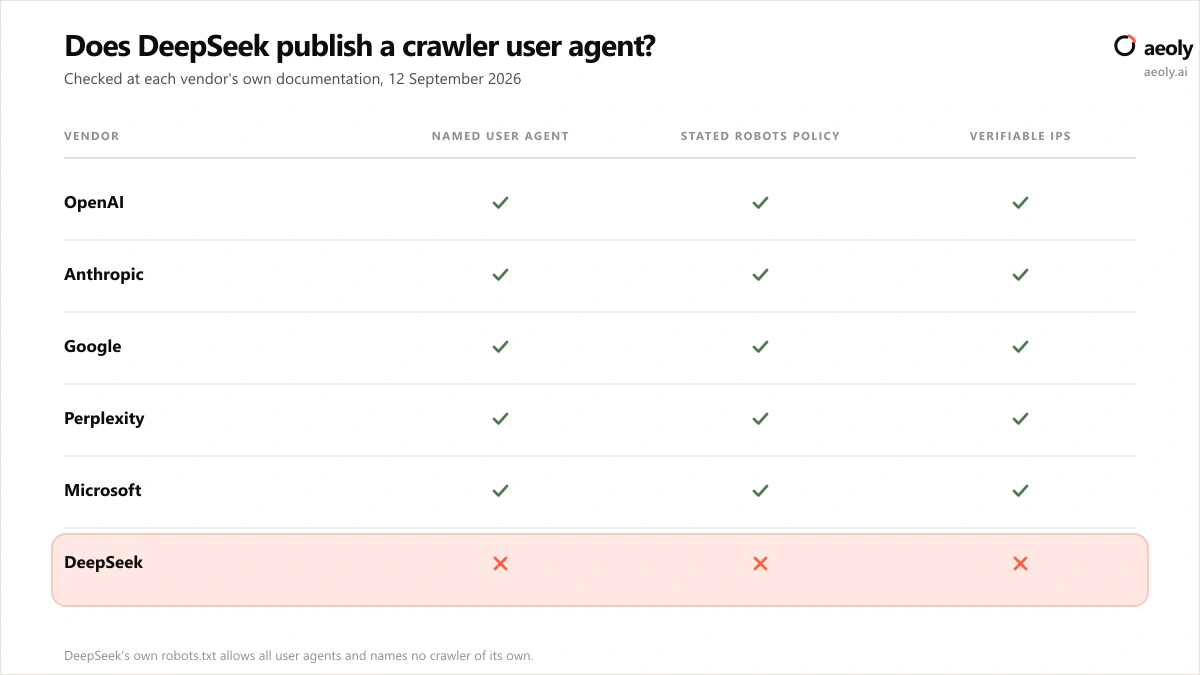
The file itself is the shortest way to see it. Four lines, one group, a sitemap, and no crawler of DeepSeek's own named anywhere.
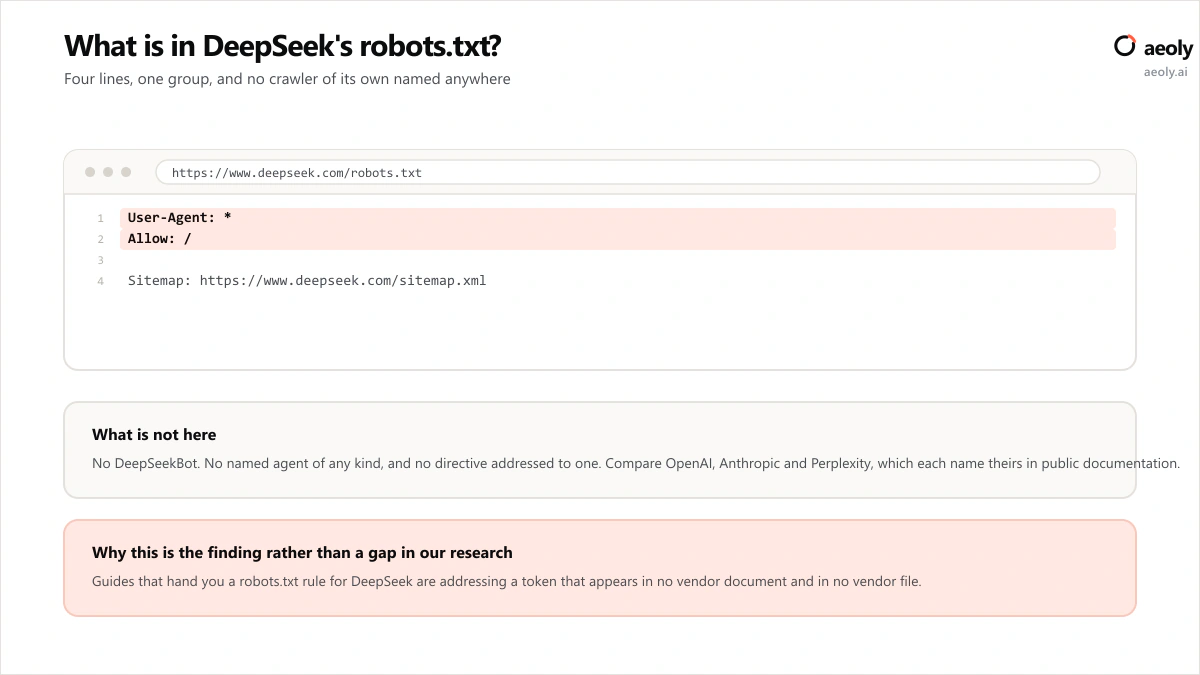
Compare that to the vendors who do publish. OpenAI names four agents and says what each one does. Anthropic names three and states its robots.txt position for all of them. Perplexity names two and publishes IP ranges for both. DeepSeek names none of this publicly.
Why do DeepSeek SEO guides disagree with each other?
The secondary sources are not merely thin, they contradict one another. Some list a DeepSeekBot user agent string with a version number. Others state that DeepSeek publishes no crawler user agent at all and that its fetches resemble ordinary browser traffic. At least one asserts that the bot ignores robots.txt.
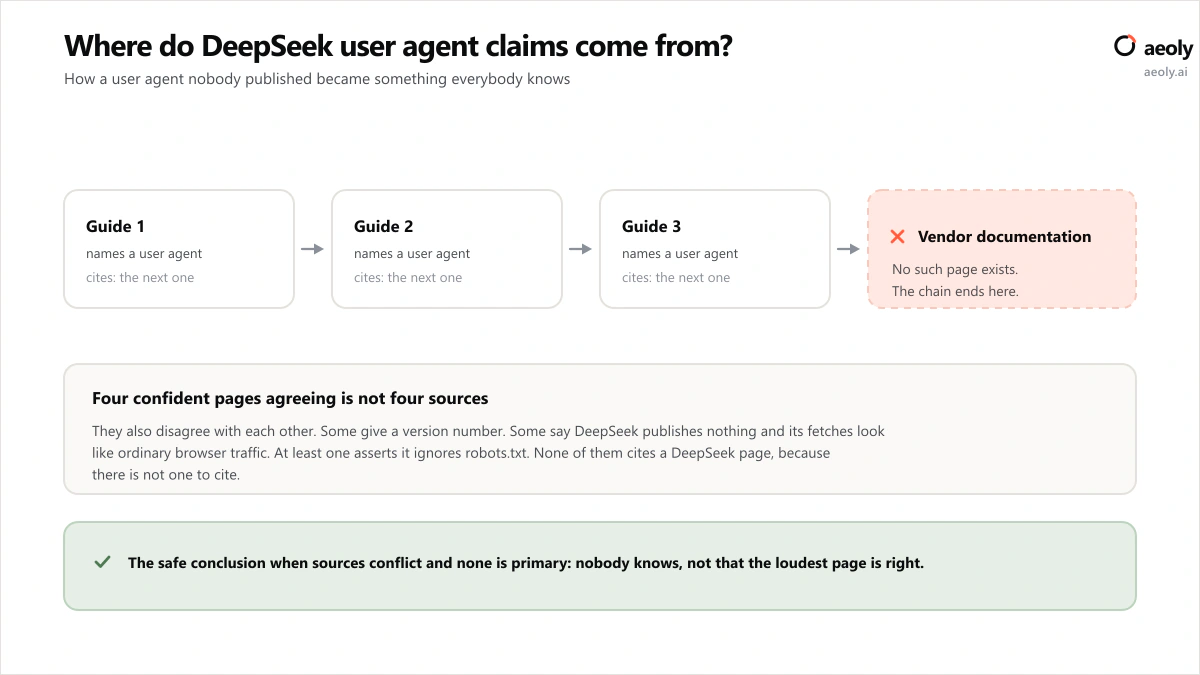
When several confident pages disagree and none cites a vendor document, the safe conclusion is that nobody knows, not that the loudest page is right.
This is a general hazard now, not a DeepSeek quirk. A great deal of what ranks for technical questions is summarised from other summaries, and a fabricated user-agent string repeated four times still has no source behind it.
How do I identify an undocumented crawler?
You cannot write a robots.txt rule for a token you cannot name. What you can do is find out what is actually visiting you, which is a better habit anyway.
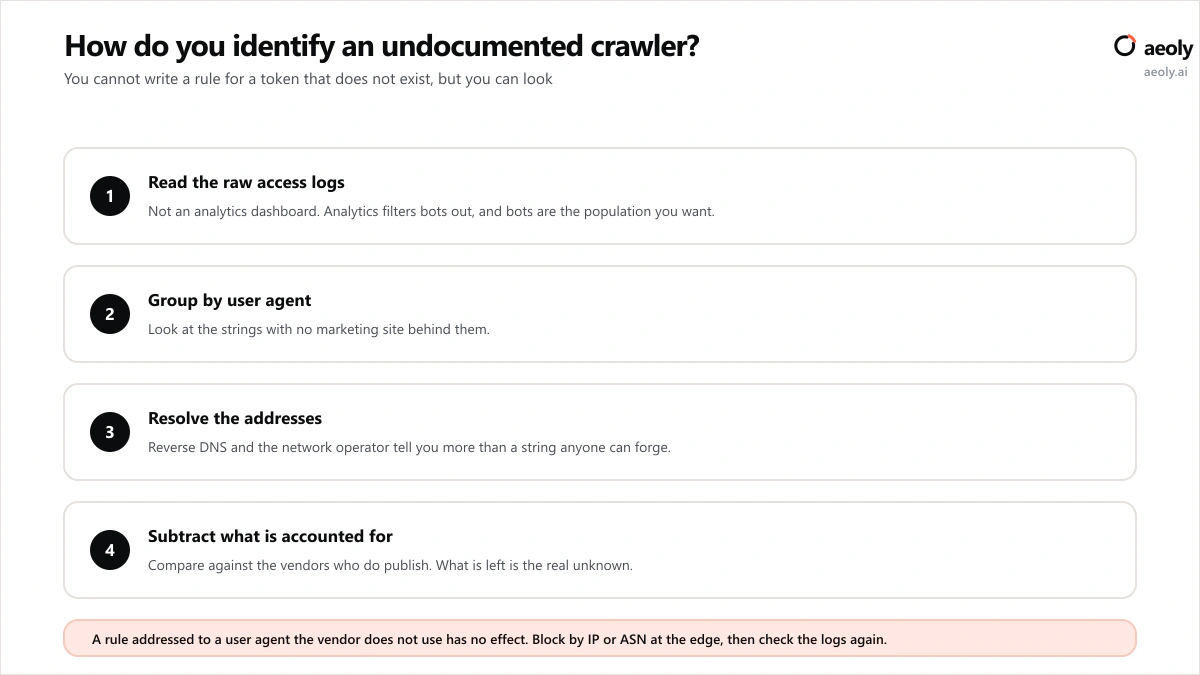
If you find traffic you cannot attribute and want it gone, block by network at the edge rather than by guessing at a robots.txt token. A rule addressed to a name nobody uses does nothing at all.
For the crawlers that do publish a token, none of this guesswork is necessary. The AI crawler checker reads your robots.txt and reports all eleven documented AI user agents, which is the set you can actually govern from your own server. DeepSeek is not among them, for the reason this post has been making.
Does DeepSeek read JavaScript-rendered pages?
With a documented crawler you can look up whether it executes JavaScript. With an undocumented one you cannot, which makes server-rendered HTML the only safe assumption.
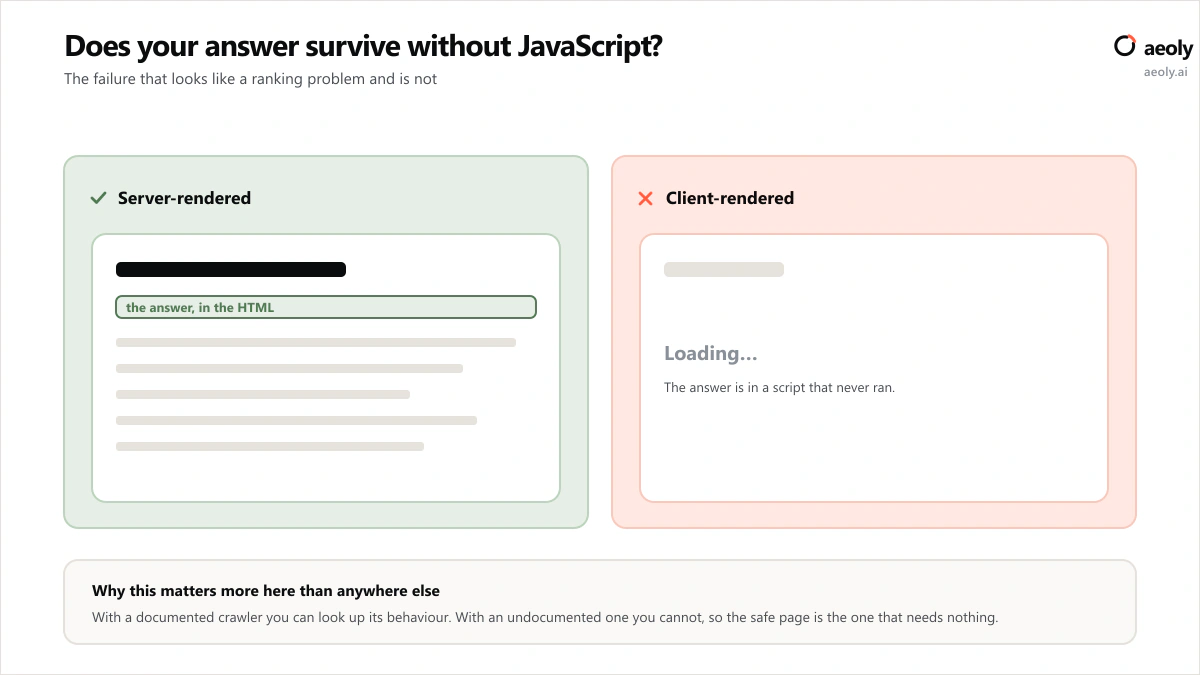
A page whose answer arrives only after a script runs is a page that some fetchers will receive as an empty shell. This is checkable in about ten seconds: fetch your own URL with curl and look for the answer in the response, or let a site audit do it across every page at once. It is the same check that decides whether a page can rank at all, which is the point.
How should I structure a page when the vendor documents nothing?
Write for a fetcher that runs no JavaScript, announces nothing, and reads the page once. That is the lowest common denominator across every assistant, documented or not, and a page built for it works everywhere without a per-vendor variant.
The useful thing about an undocumented crawler is that it forces the question most SEO advice avoids: what does this page do if none of the optimisations apply? Strip out the schema, the robots.txt tuning and the vendor-specific tricks, and what is left is the part that was always doing the work.
- The answer is in the HTML, not assembled by a script after load.
- The answer is in the first paragraph under a heading that asks the question.
- The page carries at least one fact that cannot be sourced from three other pages.
- The fact has a date and a method attached, so it can be checked rather than merely believed.
- The page is reachable: linked from somewhere, in a sitemap, and not disallowed by a rule somebody added during an incident and forgot.
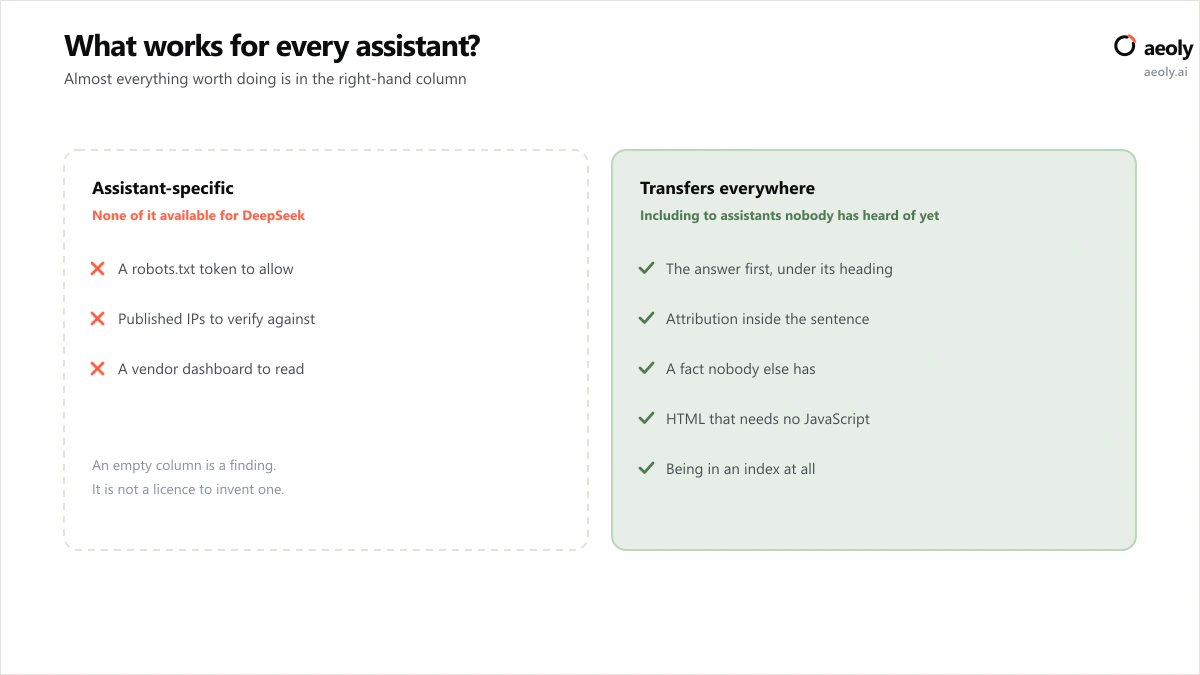
None of that is DeepSeek advice. That is the point of it. A page meeting those five conditions is eligible everywhere, and a page failing them is not rescued by any robots.txt token, published or invented.
What should I not do about DeepSeek?
Do not copy a robots.txt rule from a guide that names a user agent no vendor publishes. It has no effect, it clutters a file that should be readable, and it creates a false sense that the question has been handled.
Three other things are worth avoiding, and all of them are being recommended somewhere.
- Do not block traffic you have not identified. A rule aimed at a name you found in a blog post can just as easily match nothing, or match something you wanted.
- Do not infer a policy from a single log line. A user agent string is a claim anybody can make, and the assistants that do publish IP ranges publish them precisely because the string is not evidence.
- Do not buy a report that promises DeepSeek visibility tracking without saying how it identifies DeepSeek. If the vendor cannot name the mechanism, the number is a guess with a chart around it.
An empty column in a comparison table is a finding. It is not a licence to fill it in.
The honest position is that this one assistant cannot be addressed directly with the tools the others give you, and that the work which transfers is the work worth doing anyway. A guide that pretends otherwise is inventing the missing half, and you would have no way to tell which half was invented.
What should I actually do about DeepSeek?
Not much, honestly, and anyone telling you otherwise is selling certainty they do not have. If your pages are open to the well-documented crawlers, they are open generally. The structural work that makes a page quotable does not change per assistant.
The thing worth doing is checking your logs quarterly for visitors you cannot identify. That is a good idea regardless of which company is behind them.
How to get cited by DeepSeek: the short version
Write pages that answer a question in a paragraph that survives being lifted, publish facts nobody else has, serve them in HTML, and keep your site open to the crawlers whose documentation you can actually read. Getting cited by DeepSeek is not a different discipline from the rest. It is the same discipline with less published information to work from, and a guide that pretends otherwise is inventing the missing half.
For the vendors that do document themselves, start with ChatGPT and Claude, which between them cover seven named user agents and two different positions on user-initiated fetching.
More questions
Does DeepSeek have an official crawler user agent?
None that could be verified at the source in September 2026. DeepSeek's website robots.txt names no bot of its own and its public documentation covers the API rather than web crawling. Third-party guides name a DeepSeekBot token, but they do not cite a DeepSeek document and they disagree with each other about whether it honours robots.txt.
Can I block DeepSeek in robots.txt?
You can write a rule, but a rule addressed to a user-agent token that the vendor does not publish or use has no effect. If you need to stop traffic you cannot identify, block it at the network edge by IP or ASN and verify from your access logs that it stopped.
Why do other articles give a specific DeepSeek user agent?
Because it is repeated widely enough to look settled. Follow the citations and they lead to other summaries rather than to a vendor page. That pattern is common for technical questions where a real answer was never published, and it is worth checking before you copy a rule into production.
Is there anything DeepSeek-specific worth doing at all?
Reading your access logs quarterly, which is worth doing regardless of who is behind the traffic. Beyond that, no: with no published user agent, no stated robots.txt policy and no verifiable IP ranges, there is no lever to pull that is specific to this vendor. The structural work that makes a page quotable is not vendor-specific in the first place.
Will optimising for the other assistants cover DeepSeek?
Probably, and nobody can tell you for certain, which is itself the answer. A page that is server-rendered, answers its question in the opening paragraph, and carries a checkable figure is eligible for any retrieval system that can reach it. That is the strongest claim the evidence supports.
Should I treat unnamed crawlers as a security problem?
Treat them as an unknown to identify rather than a threat to panic about. Most are legitimate services with poor documentation. The useful response is the same either way: read your logs, resolve the addresses, and decide deliberately rather than by default.
Article sources
- deepseek.com/robots.txt, which names no crawler of its ownDeepSeek
- DeepSeek API documentation, which covers models rather than crawlingDeepSeek
- AI crawler robots.txt survey, 52 sitesAeoly. Method and site list in scripts/ai-crawler-survey.ts
How to get cited by DeepSeek
- How to get cited by DeepSeek
- Does DeepSeek have a crawler user agent?
- Why do DeepSeek SEO guides disagree with each other?
- How do I identify an undocumented crawler?
- Does DeepSeek read JavaScript-rendered pages?
- How should I structure a page when the vendor documents nothing?
- What should I not do about DeepSeek?
- What should I actually do about DeepSeek?
- How to get cited by DeepSeek: the short version