How to get cited by ChatGPT
Two OpenAI crawlers, two completely different jobs. Block the wrong one and you vanish from ChatGPT search while still feeding the training set.
How to get cited by ChatGPT
- How to get cited by ChatGPT
- Which OpenAI crawler controls ChatGPT citations?
- How many sites block OAI-SearchBot?
- What makes a page worth citing?
- How does ChatGPT choose which retrieved pages to cite?
- How should I structure a page to be cited?
- Why does ChatGPT cite competitors instead of me?
- How do I check my robots.txt for AI crawlers?
- How to get cited by ChatGPT: the short version
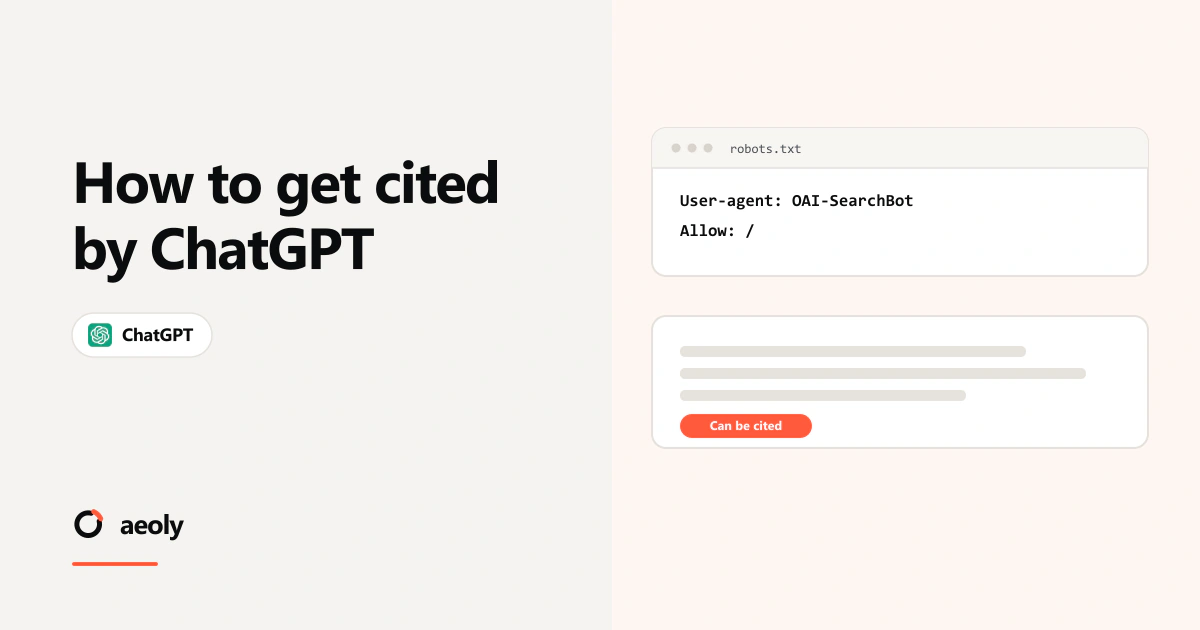
If you want to get cited by ChatGPT, one line in your robots.txt decides it: whether OAI-SearchBot is allowed to read your pages. OpenAI's own documentation is blunt about the consequence. Sites that are opted out of OAI-SearchBot will not be shown in ChatGPT search answers.
Most sites that block it did not mean to.
How to get cited by ChatGPT
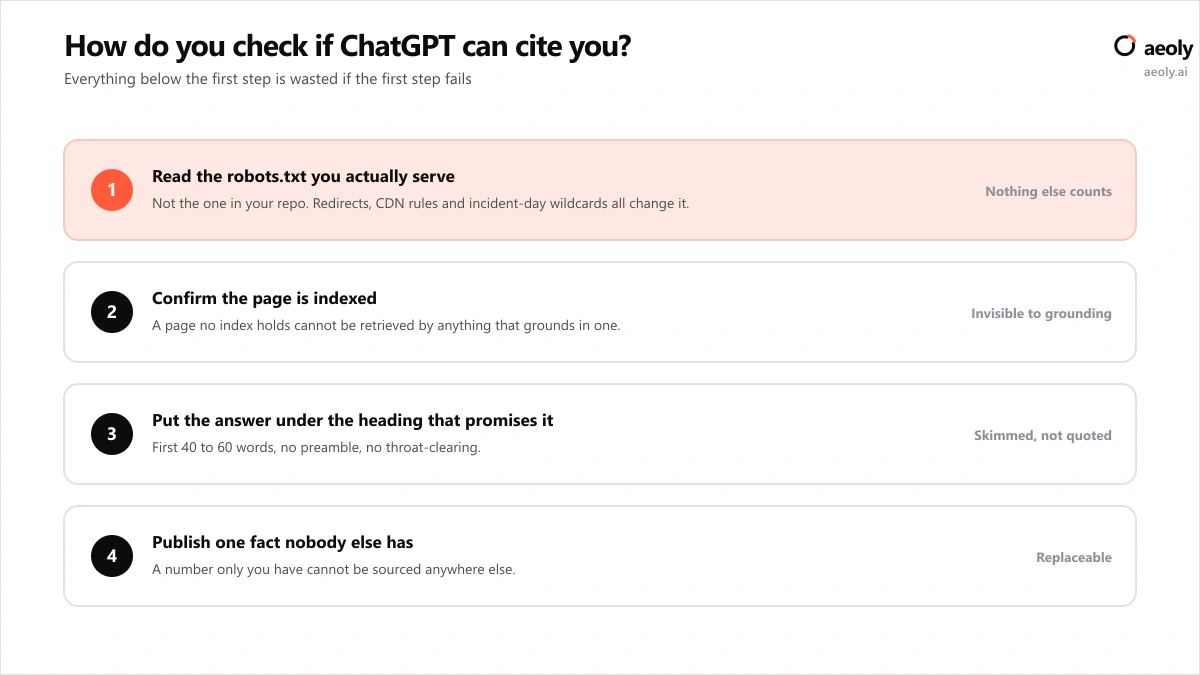
To get cited by ChatGPT, allow OAI-SearchBot in robots.txt, answer each question in the first 40 to 60 words under the heading that asks it, name your sources inside the sentence rather than only in a link, and publish at least one figure no other page has. The first step is the one most sites get wrong.
Here is the whole robots.txt side of it. If your file already looks like this, the access question is settled and the rest is writing.
robots.txt
# The crawler that decides whether ChatGPT can cite you.
User-agent: OAI-SearchBot
Allow: /

# Training data. A separate decision, with no effect on citations.
User-agent: GPTBot
Allow: /
Disallow: / in either group opts you out of that one thing and nothing else. The two groups are independent.
Then check what you actually serve, which is not always what is in your repository. A CDN rule, a redirect, or a wildcard somebody added during an incident can all produce a robots.txt you did not write. One command settles it:
Terminal
curl -s https://yoursite.com/robots.txtRead the whole file. If OAI-SearchBot is not named in it, it falls to your wildcard group, and a site-wide Disallow there blocks it just as effectively as naming it would.
If you would rather not do that by hand, the free AI crawler checker reads your robots.txt and reports OAI-SearchBot, GPTBot and nine other tokens at once, with the exact directive that decided each one. No account, and it never guesses: a file it cannot parse is reported as unknown rather than as permission.
Three things are worth knowing before you spend a week on the writing half.
- Allowing the crawler makes citation possible, not scheduled. There is no queue to join and no submission form. It depends on being crawled again and on your page answering a question better than the pages already being quoted.
- Nothing here is retroactive. A page that was blocked while the crawler passed is not cited the moment you unblock it. It has to be fetched again.
- You cannot verify the result by asking ChatGPT once. The same question asked twice can return different sources, so a single check tells you almost nothing. Ask on a schedule and watch the trend.
The rest of this post is what each of those four steps means in practice, starting with the only one that can make the other three irrelevant.
Which OpenAI crawler controls ChatGPT citations?
OAI-SearchBot controls whether ChatGPT can cite you. OpenAI describes it as the crawler used to surface websites in search results in ChatGPT's search features, and states that sites opted out of it will not appear in ChatGPT search answers. GPTBot is a separate crawler for training data, and blocking it has no effect on citations.
OpenAI documents four user agents, and they do different jobs. Reading the list once saves an expensive mistake.
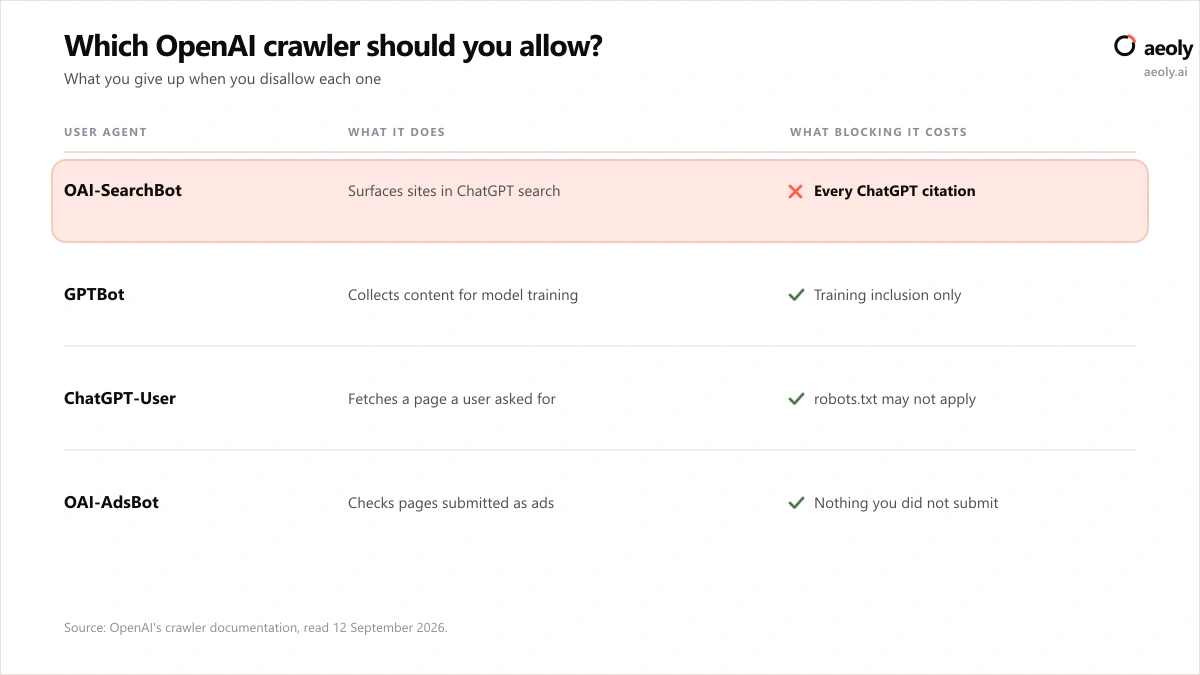
The mistake is treating the first two as one decision. A publisher who does not want their archive in a training corpus blocks GPTBot, which is a coherent position. A publisher who blocks OAI-SearchBot has opted out of being quoted by an assistant with hundreds of millions of weekly users, usually without realising the two lines mean different things.
How many sites block OAI-SearchBot?
We checked. Of 48 sites whose robots.txt we could read on 12 September 2026, 6 disallowed OAI-SearchBot at the root, about 13 percent, and 10 disallowed GPTBot. The two groups are not the same sites, which is the interesting part.
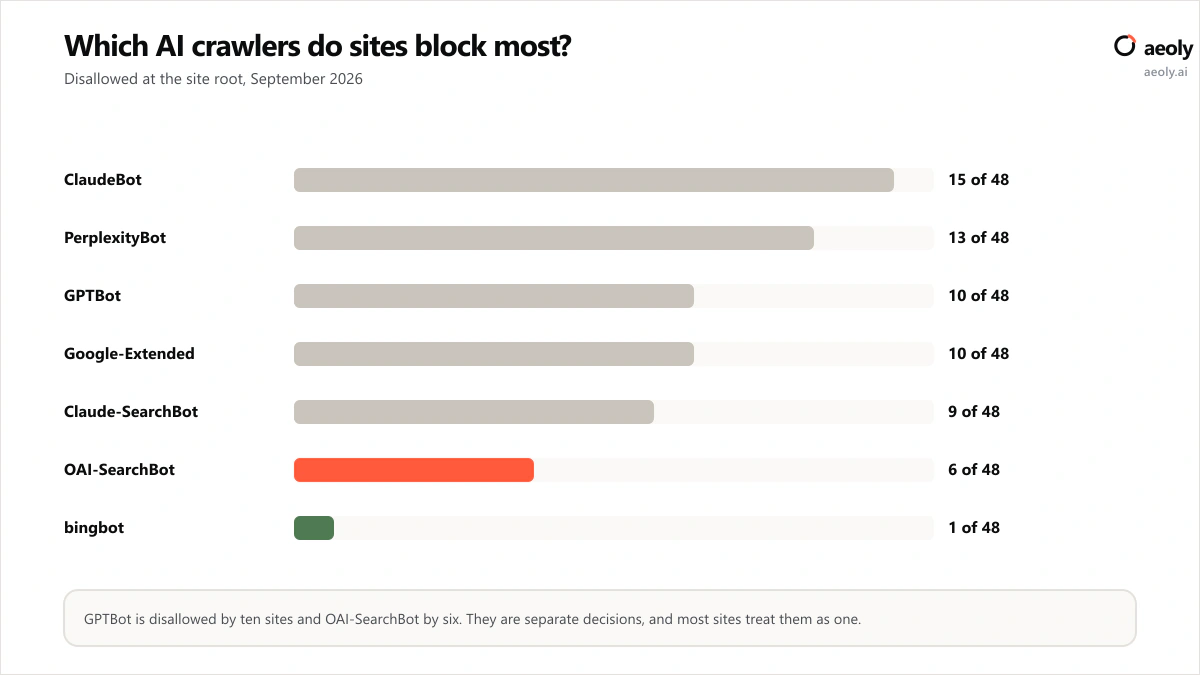
Reuters allows OAI-SearchBot and disallows GPTBot: cite me, do not train on me. The Guardian allows both OpenAI crawlers while disallowing both of Anthropic's. The BBC disallows both. Reddit now disallows every crawler in the survey, bingbot included.
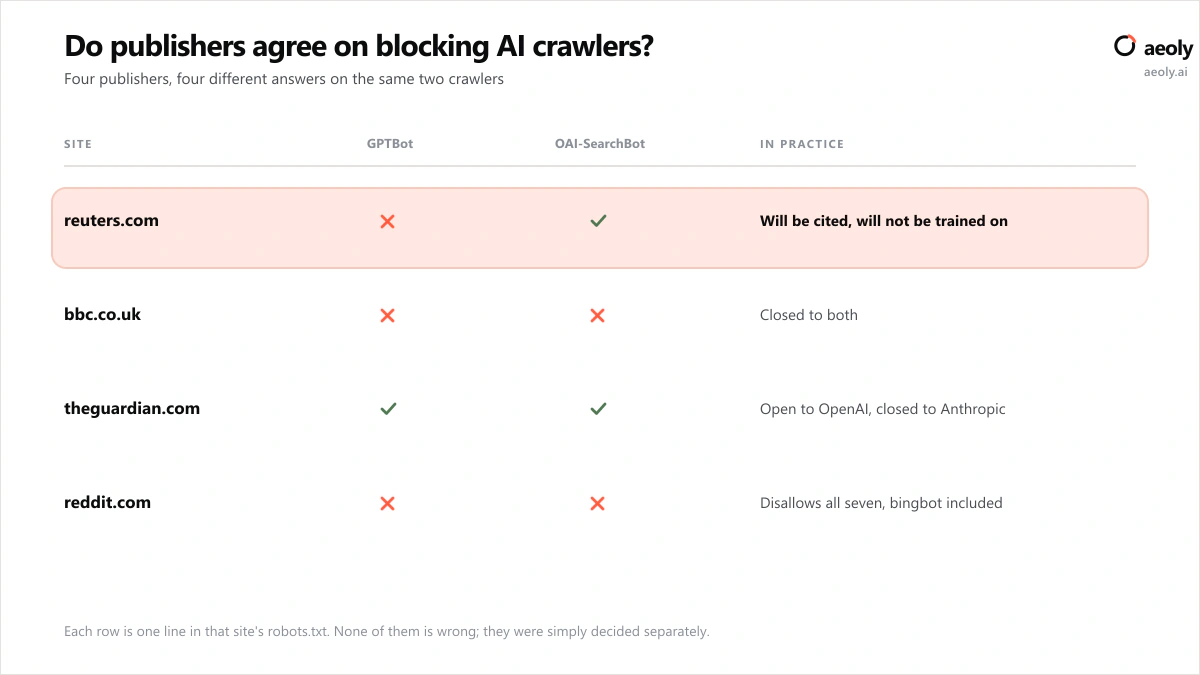
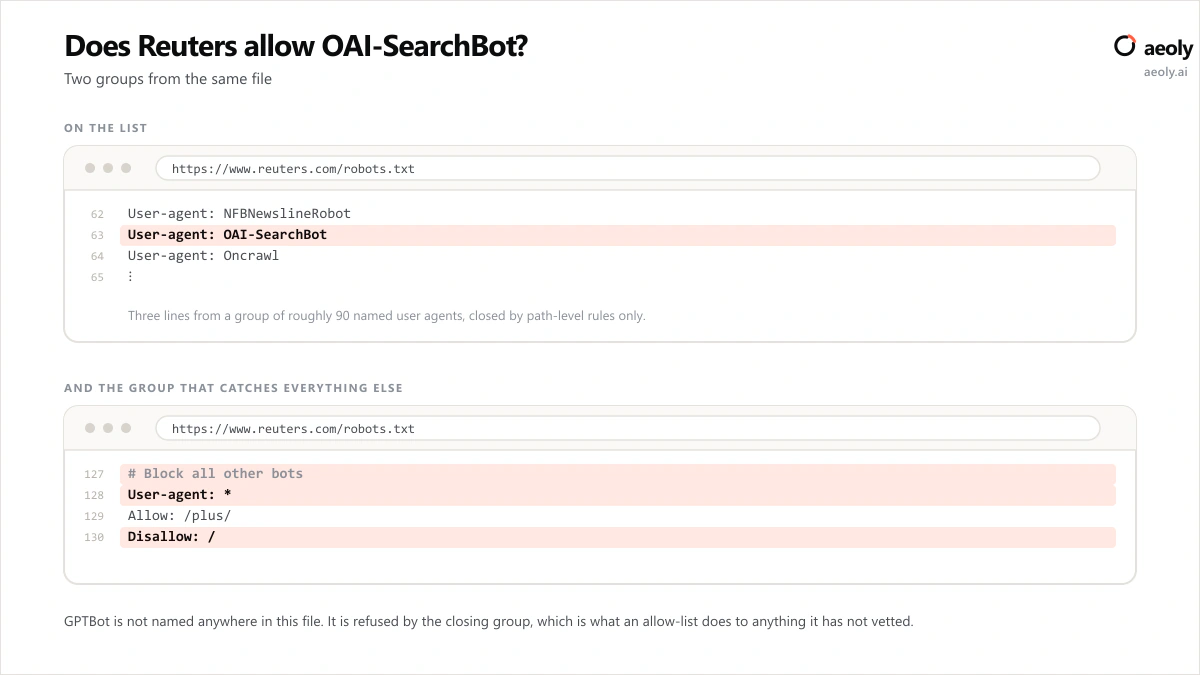
Reddit went the other way, and did it to everyone. Its entire robots.txt is five comment lines and one group disallowing all crawlers from the whole site, which is why it is the only site in the survey that refuses every assistant we tested.
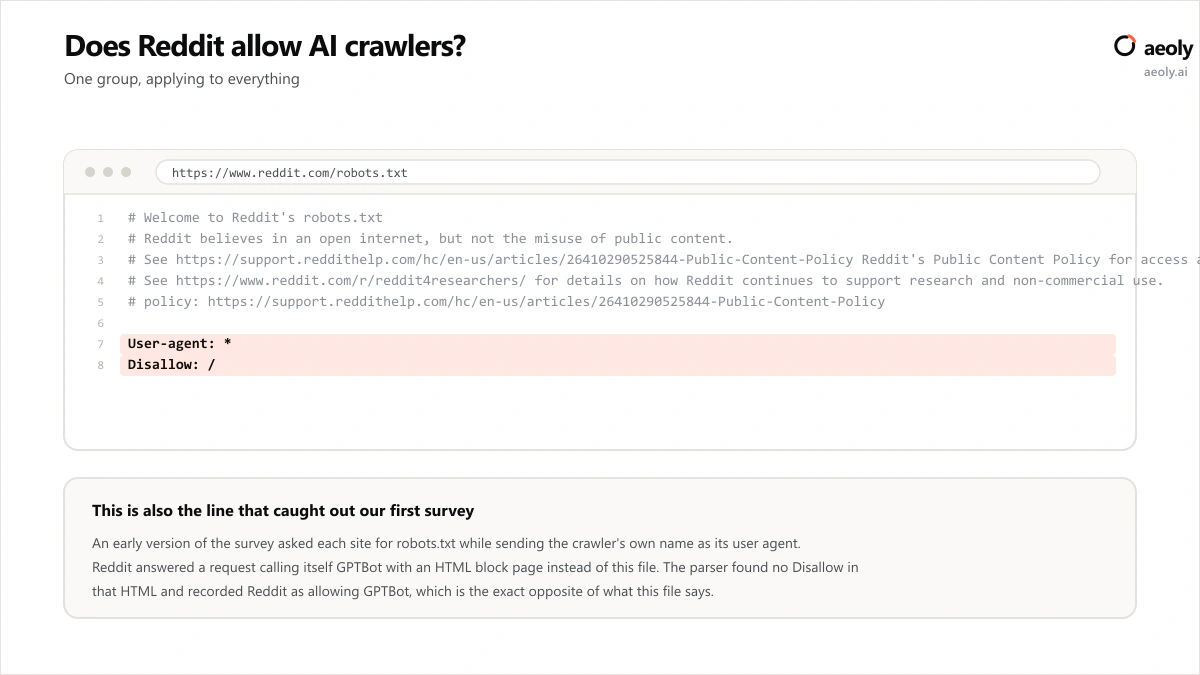
These are not consistent policies applied by an industry. They are separate decisions made at different times by different people.
Figures come from Aeoly's robots.txt survey of 52 well-known sites, run on 12 September 2026. Each site's robots.txt was read once with our own user agent and all seven crawler tokens were evaluated against that one file. 48 sites returned a readable robots.txt and the other 4 are excluded rather than counted as permissive. The survey reads robots.txt only and never crawls the sites themselves.
Blocking clusters almost entirely in news: 9 of the 10 news sites disallow at least one assistant crawler. Among the 7 documentation sites, none did. Among 15 SaaS marketing sites, one did, and only for the training crawlers.
If you sell software, your competitors are not blocking these crawlers. Being cited is a question of what your pages say, not who you keep out.
What makes a page worth citing?
Access is the floor, not the goal. An assistant composing an answer needs a passage it can lift without losing meaning, and it needs a reason to trust the passage.
The most common structural failure is putting the answer in the middle. A page can contain the correct answer and still never be quoted, because the sentence that answers the question only makes sense with the eight paragraphs above it attached.
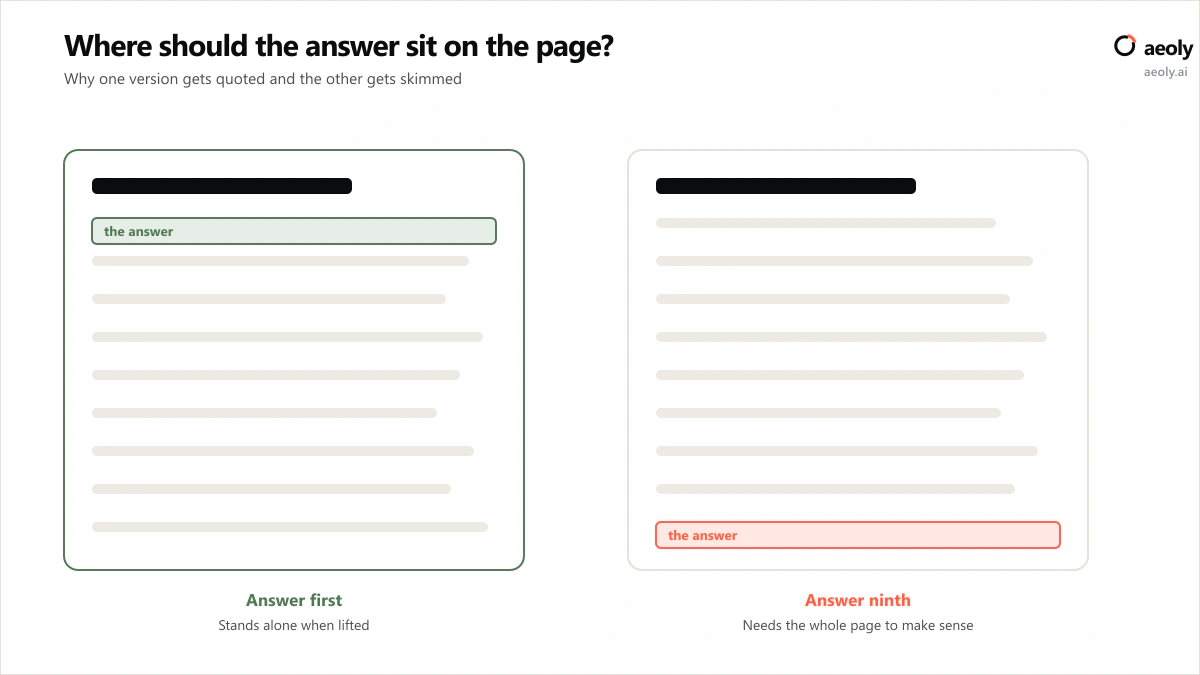
- Answer the question in the first 40 to 60 words under the heading that asks it, so the answer survives being extracted with no surrounding context.
- Write in definitive language where you can defend it. A sentence that says what a thing is gets quoted; a sentence that says a thing may in some cases be considered is not an answer, it is a hedge with a word count.
- Name the source inside the sentence carrying the statistic, not only in a link. An assistant quoting you will carry the attribution across.
- Publish a number nobody else has. Original data is the strongest citation magnet available, because a model that ignores your opinion will still quote your figure.
How does ChatGPT choose which retrieved pages to cite?
It retrieves far more than it uses. A study by Ahrefs of 1.4 million prompts reports roughly 33 URLs pulled per prompt and about half of them cited, with 88 percent of the citations arriving through the ordinary web search channel rather than any special feed. Being in the search pool is the precondition.
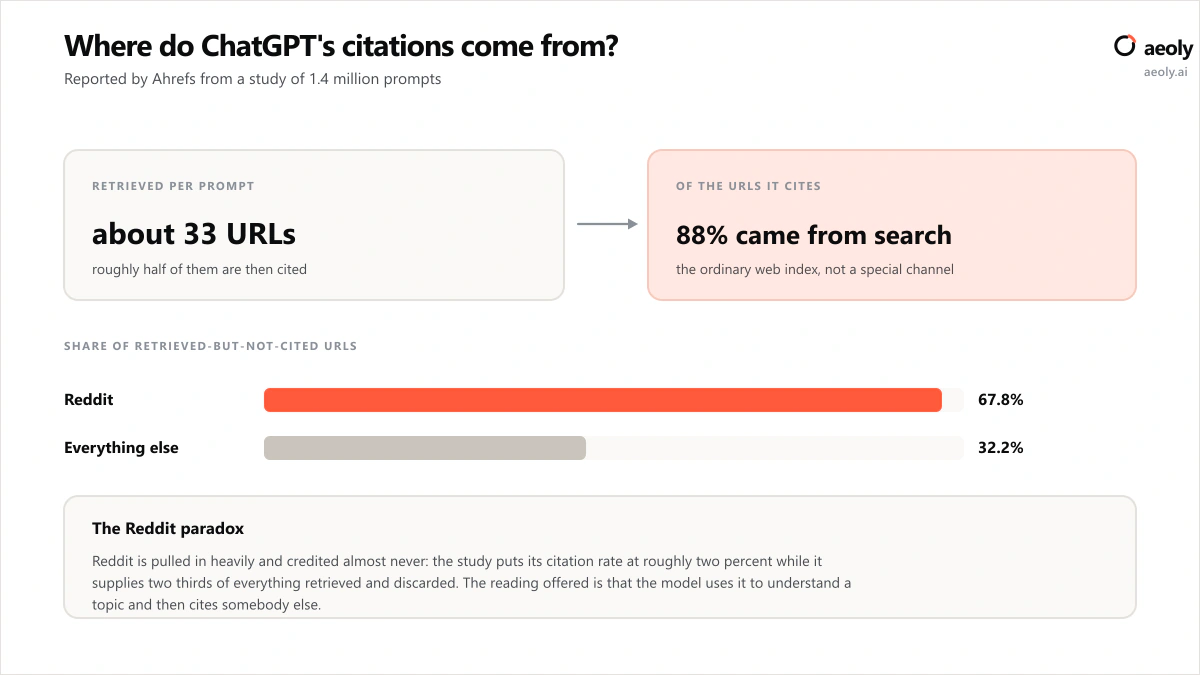
Two things follow from that, and both are more useful than most of the advice written about this.
The first is that a gatekeeping step happens before your page is opened at all. Retrieval returns a title, a short snippet and a URL, and the decision about which of those results are worth opening is made from that alone. Whatever is excellent on the page cannot influence a choice made before the page is read. Your title and your URL are doing that work by themselves.
The second is that the question your page is matched against is usually not the question the user typed. The model expands a prompt into several internal sub-questions and searches those separately, and the study found cited pages had higher title similarity to those sub-questions than to the original prompt.
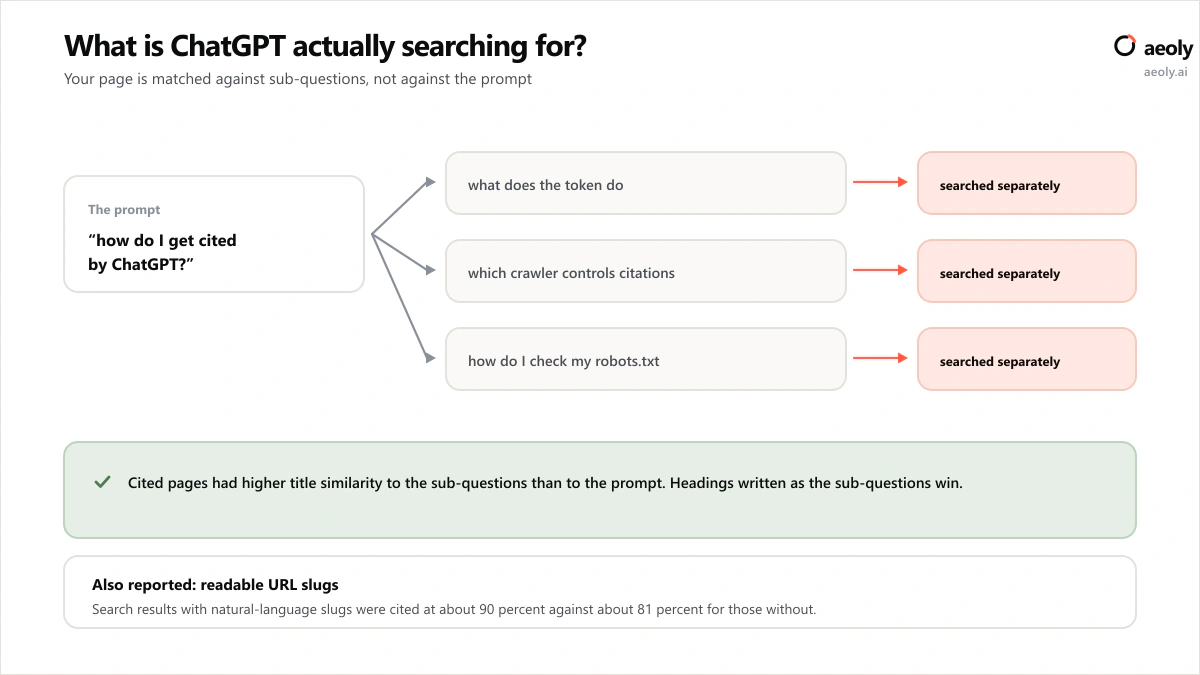
That is directly actionable, and it is the same instinct as writing headings for the queries people actually type rather than for the topic in your head. Ask the assistant your buyer's question with search on, look at what it went and searched for, and use that language for your H2s. Two related findings from the same study are worth knowing while you do it.
One important limit before you act on it. This finding is about ChatGPT, and it does not transfer to Google. Google's own guidance on generative AI features states that creating separate content specifically to target fan-out queries violates its spam policies, which is covered in how to get cited by Gemini and AI Overviews. Writing a section that answers a real sub-question your readers have is fine everywhere. Spinning pages to match strings a model generated is not, and one of the two platforms has said so in writing.
- Readable URL slugs were cited at around 90 percent against around 81 percent for opaque ones. Not decisive, close to free, and it costs nothing on a page you have not published yet.
- Within a single retrieval set, older established pages tended to be cited and the very freshest pages tended to be retrieved and discarded, with a median cited age near 500 days. Publishing something today does not put it in front of a page that has been answering the question for a year.
- News is the exception. There the relevance scores for cited and uncited pages were close enough that page age became the tiebreaker, and younger won.
The Reddit figure in that study deserves its own sentence, because it refines something this post says above. Reddit supplied around two thirds of the URLs that were retrieved and then not cited, at a citation rate of roughly two percent. The reading the authors offer is that the model reads Reddit to understand a topic and to gauge what people agree on, and then credits somebody else.
Being read is not the same as being cited. A channel can shape the answer about you and never appear beneath it.
So the earlier advice stands and gets sharper: community threads matter for what an assistant believes about you, and they are not where the citation lands. If you are choosing where to spend, the page that can be cited is the one on a domain you control and that ranks.
The usual caution applies to all of it. This is one company's measurement of a closed system, published by a firm that sells search tooling, and the relevance figures are approximations produced with open-source embedding models rather than anything OpenAI documents. It is the best evidence available on the question and it is still not the same class of fact as the robots.txt behaviour above.
How should I structure a page to be cited?
Put a self-contained answer of roughly 40 to 60 words directly under the heading that asks the question, keep links out of that paragraph, and follow it with a number no other page has. Those three moves are the ones third-party citation audits keep finding in pages that get quoted.
A word on where that comes from, because it is not the same class of evidence as the rest of this post. Everything above is read from OpenAI's own documentation or measured by us. What follows is pattern-matching by other people on samples of cited pages, reported by outlets including Search Engine Land. It is correlation on somebody else's sample, and several of the firms publishing it sell services that the findings happen to recommend. Treat it as a sensible prior rather than a law, which is also how the people who ran the audits describe it.
With that stated, the patterns are consistent enough to act on.
- The answer capsule is the single most repeated finding. Audits put it in roughly seven of every ten cited blog posts: a short, complete answer sitting immediately after the heading, before any context or caveat.
- Keep it clean of links. In one audit over nine in ten cited capsules contained no internal or external links at all, which is the opposite of the usual instinct to link the first mention of everything.
- Front-load the page. Around 44 percent of citations were drawn from the first third of the content, so an answer in paragraph nine is competing for a slot that was mostly decided by paragraph three.
- Pair the capsule with original data. Capsule plus a proprietary number was the strongest-performing combination in the sample, and it is the one competitors cannot copy by rewriting.
- Write the heading as the question, in the words a person would type, so the capsule under it reads as the answer to something rather than the start of an essay.
- Use definitive language where you can defend it. A sentence that says what a thing is can be quoted; a sentence that says a thing may in certain circumstances be considered cannot.
Here is the shape, since it is easier to copy than to describe. The heading is the question, the first paragraph is the whole answer with nothing else in it, and the supporting detail starts afterwards.
Page structure
## Does blocking GPTBot stop ChatGPT citing my site?

No. GPTBot governs training data collection and OAI-SearchBot
governs whether your pages can appear in ChatGPT search answers.
They are separate tokens in robots.txt, and blocking the first
has no effect on the second.

<!-- Context, caveats, links and examples start here, not above. -->
That answer is 44 words, contains no links, and makes sense with the rest of the page removed. Those are the three properties worth testing for.
The test for whether a capsule works is blunt: delete the rest of the page and read the paragraph on its own. If it still answers the question, it can be lifted. If it needs the heading above it or the sentence after it, it cannot, and it will lose to a page whose version can.
Why does ChatGPT cite competitors instead of me?
Here is the part most guides skip. ChatGPT rarely takes one page's word for a claim about a company. It composes from several sources and leans toward what they agree on, which means your own page is one input among several rather than the answer.
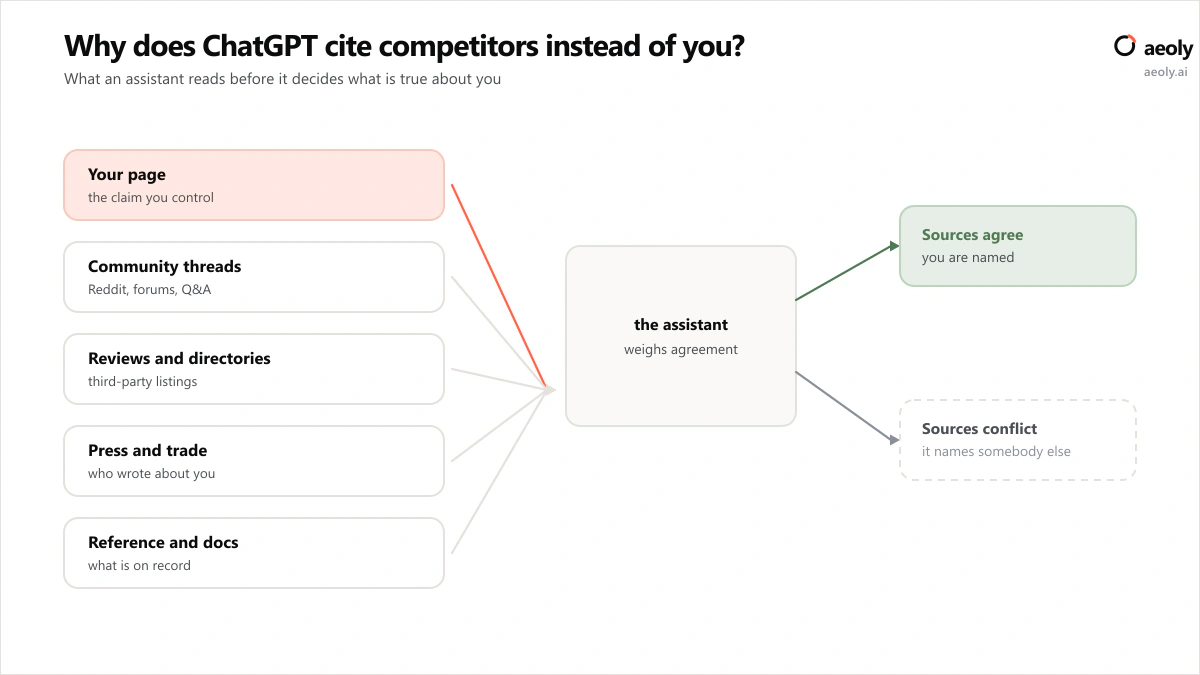
The practical consequence is that off-site presence is not a separate marketing activity from citation work, it is part of it. Where the community threads, the directories and the trade press agree with your page, your page gets used. Where they contradict it or say nothing, the assistant reaches for whoever it can corroborate.
This is also why the advice to simply write better content is incomplete. Writing better fixes the pages you control, and most of what an assistant reads about you sits on somebody else's domain.
How do I check my robots.txt for AI crawlers?
Reading your own robots.txt is a two minute job and it is not the same as knowing what a crawler sees. Redirects, a CDN rule, a staging file that shipped, a wildcard block someone added during an incident: any of these can produce a robots.txt you did not write.
Aeoly reads robots.txt on every scan and reports what it found, alongside the other checks in its site audit that decide whether a page can rank at all. Screaming Frog and Sitebulb will parse the file too if you already run them, and there is a free scan here if you would rather not install anything. The point is to look, because nobody notices this line until traffic from a channel they never measured quietly fails to arrive.
How to get cited by ChatGPT: the short version
Allow OAI-SearchBot. Decide about GPTBot separately and on its own merits. Then write pages that answer a question in a paragraph that stands alone, attribute your facts in the sentence rather than the footnote, and publish at least one number that exists nowhere else. That is the whole method, and the first step is the one most sites get wrong.
The same split shows up at every vendor with different names on it. Anthropic runs three crawlers rather than two, which is covered in how to get cited by Claude, and Google's control is not a crawler at all, which is the subject of how to get cited by Gemini and AI Overviews.
More questions
Does blocking GPTBot stop ChatGPT citing my site?
No. GPTBot governs training data collection. OAI-SearchBot governs whether your pages can appear in ChatGPT's search answers. They are separate tokens in robots.txt and blocking the first has no effect on the second. OpenAI documents both, along with ChatGPT-User for user-initiated fetches and OAI-AdsBot for pages submitted as advertisements.
Will ChatGPT respect robots.txt when a user asks it to visit my page?
Not necessarily. OpenAI's documentation says that because those actions are initiated by a user, robots.txt rules may not apply to ChatGPT-User. A person who pastes your URL into ChatGPT can generally have it fetched regardless of your robots file. The crawler you can control is the one that decides unprompted citations.
How long after allowing the crawler will I be cited?
Nobody can give you an honest number, and be sceptical of anyone who does. Allowing the crawler makes citation possible, not scheduled. It depends on being crawled again, on the question a user happens to ask, and on whether your page answers it better than the pages already being quoted.
Does schema markup make ChatGPT cite me?
OpenAI publishes no statement that it does, and several vendor studies report a correlation between structured data and AI visibility. A correlation measured by a company selling structured data services is worth reading carefully. Structured data helps machines parse a page and costs little to add correctly, so add it, and do not expect it to substitute for having something worth quoting.
Do I need to be mentioned on Reddit to get cited?
Not specifically Reddit, and as of September 2026 Reddit's robots.txt disallows every assistant crawler we tested anyway. What matters is that independent sources corroborate what your own page claims. Which sources those are depends entirely on your category.
Article sources
- Overview of OpenAI crawlersOpenAI
- Bots and crawlers referenceOpenAI developer documentation
- Why ChatGPT cites one page over another: a study of 1.4 million prompts (third-party research, not vendor documentation)Ahrefs
- How to get cited by ChatGPT: the content traits LLMs quote most (third-party audit, cited for its patterns rather than as vendor documentation)Search Engine Land
- reddit.com/robots.txtReddit
- reuters.com/robots.txtReuters
- AI crawler robots.txt survey, 52 sitesAeoly. Method and site list in scripts/ai-crawler-survey.ts
How to get cited by ChatGPT
- How to get cited by ChatGPT
- Which OpenAI crawler controls ChatGPT citations?
- How many sites block OAI-SearchBot?
- What makes a page worth citing?
- How does ChatGPT choose which retrieved pages to cite?
- How should I structure a page to be cited?
- Why does ChatGPT cite competitors instead of me?
- How do I check my robots.txt for AI crawlers?
- How to get cited by ChatGPT: the short version