How to get cited by Perplexity
Perplexity runs one crawler that respects robots.txt and one fetcher that says it generally ignores it. Knowing which is which changes what you can control.
How to get cited by Perplexity
- How to get cited by Perplexity
- Which Perplexity user agent controls citations?
- How many sites block PerplexityBot?
- What earns a numbered source slot in Perplexity?
- How should I structure a page for Perplexity?
- How do I know if it is working?
- Why does Perplexity cite competitors instead of me?
- How do I measure Perplexity citations?
- How to get cited by Perplexity: the short version
Perplexity puts numbered sources under every answer, which makes it the clearest place to see whether your citation strategy works. Whether you are eligible comes down to PerplexityBot, the crawler Perplexity describes as designed to surface and link websites in search results on Perplexity.
How to get cited by Perplexity
To get cited by Perplexity, allow PerplexityBot in robots.txt, lead every section with the answer in its first 40 to 60 words using the words the question used, and carry something no competing page has. Perplexity attaches numbered sources to each answer, and those slots go to pages that answered directly and near the top.
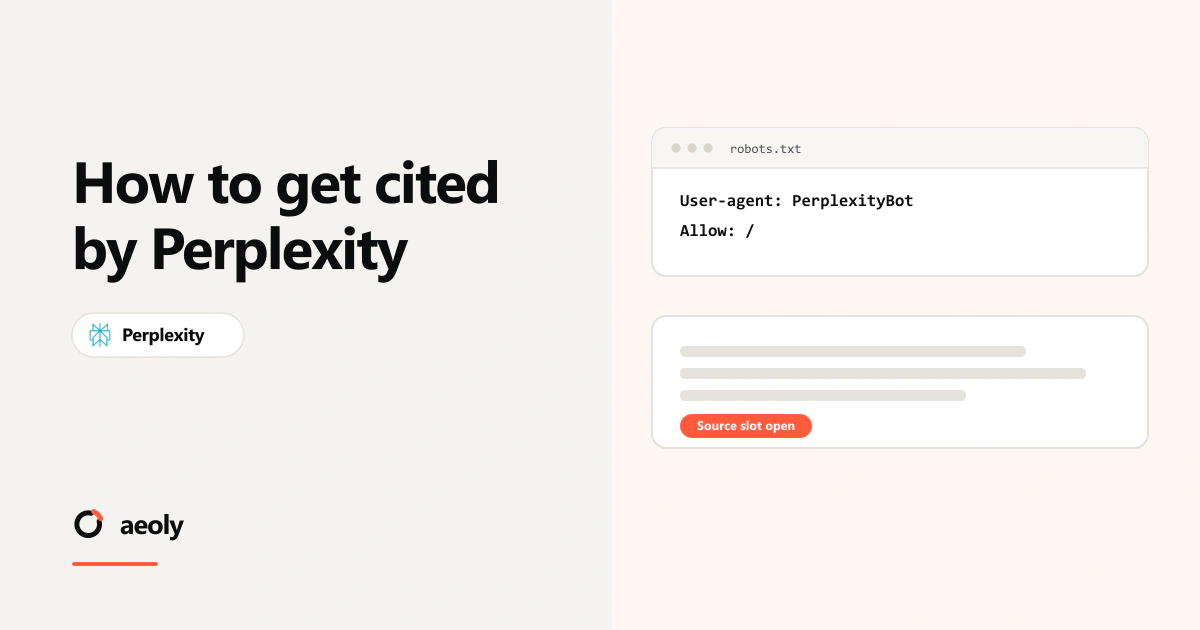
The access half is two groups, and only the first is really yours to decide.
robots.txt
# Surfaces and links your site in Perplexity results.
User-agent: PerplexityBot
Allow: /

# Fetches a page when a user's question requires it.
# Perplexity states this one generally ignores robots.txt.
User-agent: Perplexity-User
Allow: /
Both have published IP ranges, so a log line claiming to be either can be checked rather than believed.
The writing half is where Perplexity differs from the others, because you can see the result. Every answer carries numbered sources, so you can ask the question your buyer would ask and read off exactly which pages won the slots you did not.
Do that before you rewrite anything, and record three things each time:
- The exact question, in the words a buyer would use rather than the words you would.
- Whether your domain appears at all, and at which number.
- Which domains took the slots instead, and what their pages do in the first hundred words that yours does not.
That third column is the whole exercise. Nine times in ten the difference is not authority or backlinks: their page answers the question in its opening lines and yours answers it in the middle, or their page carries a number yours does not. Both of those are cheaper to fix than a reputation.
Which Perplexity user agent controls citations?
PerplexityBot controls whether Perplexity can surface and link your site. Perplexity's documentation says it respects robots.txt and is not used for AI model training. Perplexity-User is a separate agent that fetches a page when a user's question requires visiting it, and the documentation states this fetcher generally ignores robots.txt rules.
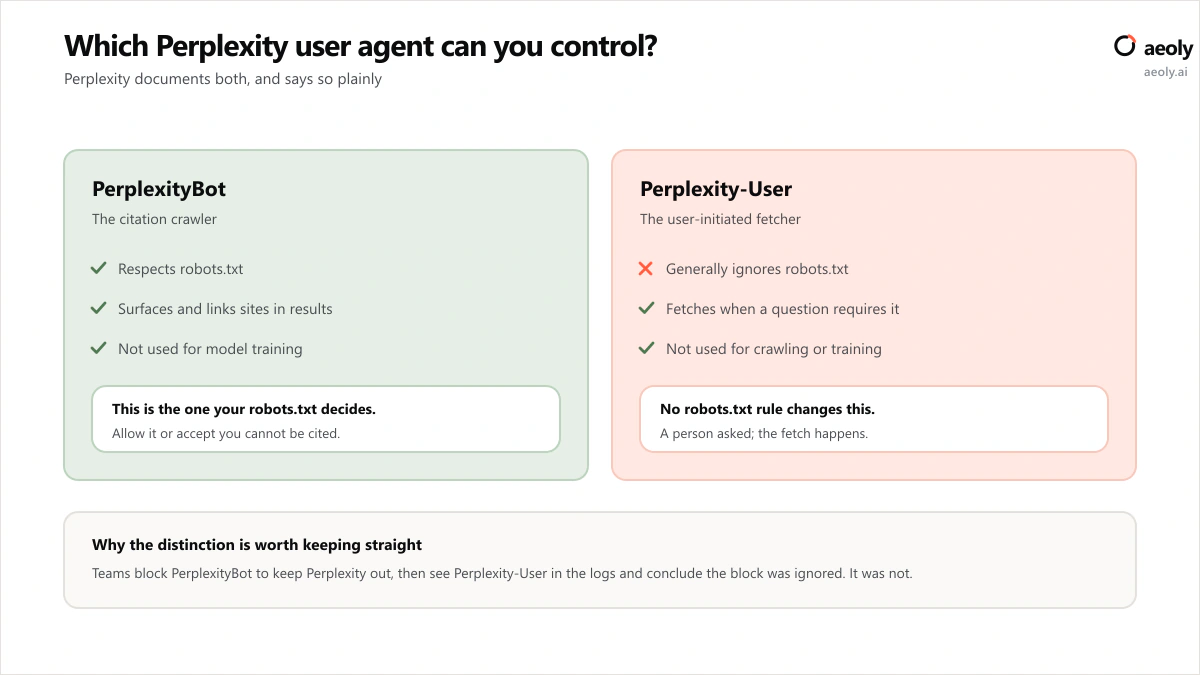
Perplexity publishes IP ranges for both, at perplexity.com/perplexitybot.json and perplexity.com/perplexity-user.json. Check your logs against those before you trust a user agent string, because the string itself is free to forge.
To see what your own robots.txt says about both, run your domain through the AI crawler checker. It reports PerplexityBot and Perplexity-User separately, along with the directive that decided each and the user-agent group it came from.
How many sites block PerplexityBot?
In our survey, 13 of 48 readable robots.txt files disallowed PerplexityBot at the root, around 27 percent. That is the second most disallowed crawler we measured, behind Anthropic's training bot and ahead of both OpenAI crawlers.
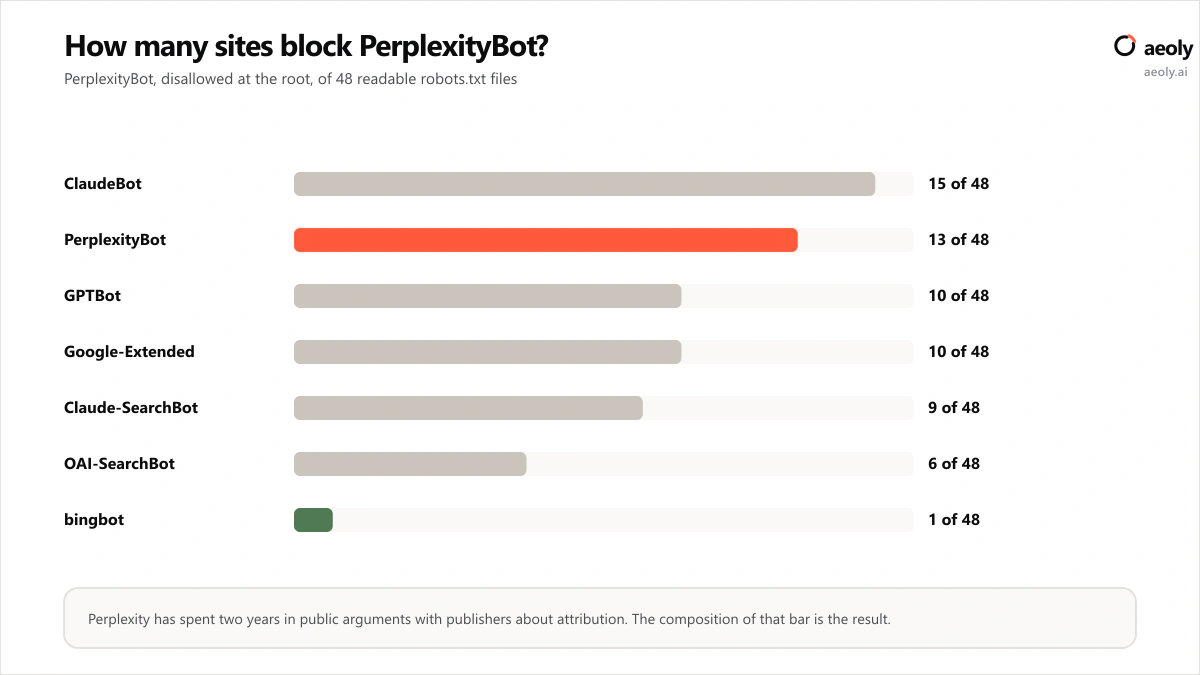
The composition tells you why. Nine of the thirteen are news organisations, and Perplexity has spent two years in public arguments with publishers about attribution. No documentation or reference site in the sample disallows it.
Figures come from Aeoly's robots.txt survey of 52 well-known sites, run on 12 September 2026. Each site's robots.txt was read once with our own user agent and all seven crawler tokens were evaluated against that one file. 48 sites returned a readable robots.txt and the other 4 are excluded rather than counted as permissive. The survey reads robots.txt only and never crawls the sites themselves.
What earns a numbered source slot in Perplexity?
Perplexity composes an answer and attaches the pages it drew from. Nobody clicks the answer. They click a number, and that number is the entire prize.
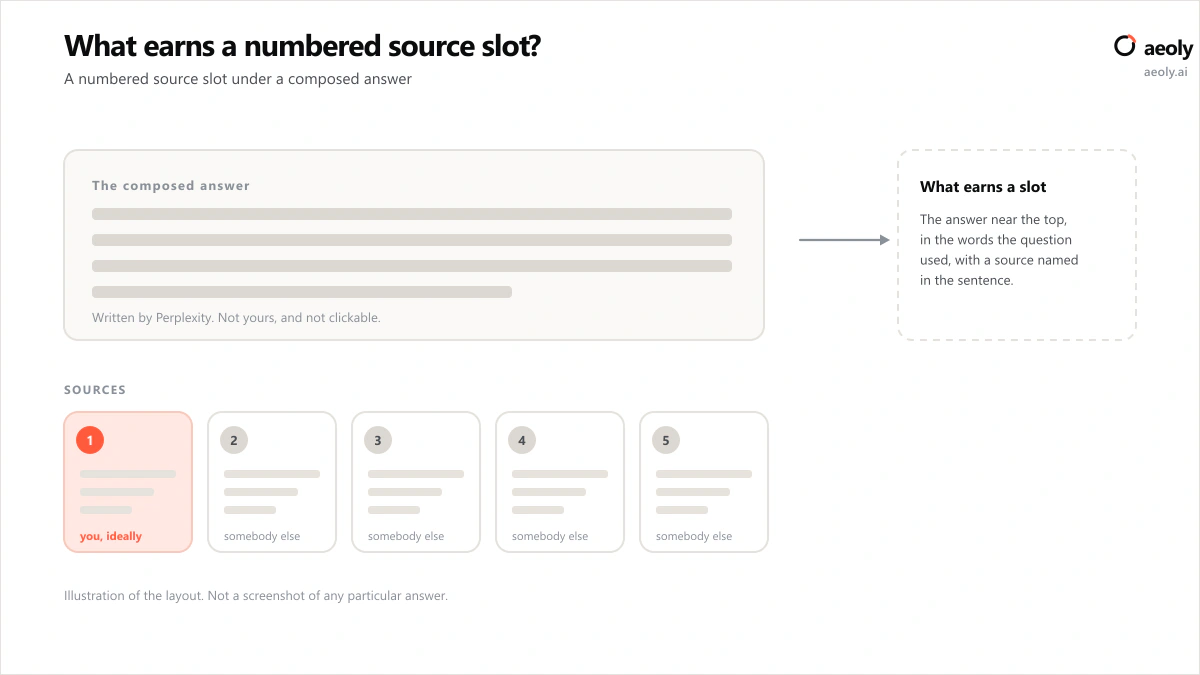
The pages that get attached tend to share a shape: they answer the question directly, near the top, in language close to how the question was asked.
An answer buried in paragraph nine of a 2,000 word essay is not a citation candidate. It is a page about the topic.
- Lead each section with the answer, in 40 to 60 words, before any context or caveat.
- Use the question as the heading, in the words a person would use.
- Give the fact a source in the same sentence, so the attribution travels when the sentence does.
- Keep the page fast. A retrieval step that has to wait on your server is a retrieval step that can time out, and nothing about your writing fixes that.
How should I structure a page for Perplexity?
Put the complete answer in the first hundred words under a heading phrased as the question, keep the page fast, and give it one fact that cannot be sourced elsewhere. Perplexity's own documentation covers crawling rather than content, so this is inference from how the product visibly behaves, and it should be read as weaker than the crawler facts above.
The reason the opening matters more here than anywhere else is visible in the interface. An answer is composed from passages, the sources are numbered beneath it, and the passages that get used are the ones that read as answers rather than as introductions.
The shape
## Does PerplexityBot respect robots.txt?

Yes. Perplexity's documentation states that PerplexityBot
respects robots.txt and is not used for AI model training.
Perplexity-User, the fetcher used when a question requires
visiting a page, generally ignores it.

<!-- Background, examples and links go below this line. -->
Two sentences, both complete, both quotable without the rest of the page. That is the unit of work.
Three things cost little and are worth doing while you are in there.
- Make the page fast. Retrieval has a budget, and a server that takes four seconds to answer is a server that can be dropped from a set it was otherwise eligible for. This is the one item on the list that your writing cannot fix.
- Use the question as the heading, in the words somebody would type. Perplexity users ask full questions far more than search users do, and a heading in your internal vocabulary will not match one.
- Date the page and the figures. Dated claims are easier to trust and easier to quote, and a stale date on a page you have actually maintained costs you nothing to fix.
How do I know if it is working?
Ask the question and read the sources. Perplexity attaches numbered sources to every answer, so the feedback loop here is shorter than for any other assistant in this series: you can see within ten seconds whether you were used, and which pages were used instead.
Do it properly rather than once. The same question can return different sources on different days, so a single check is an anecdote and a fortnight of checks is a measurement. Keep a sheet with four columns and fill it in weekly.
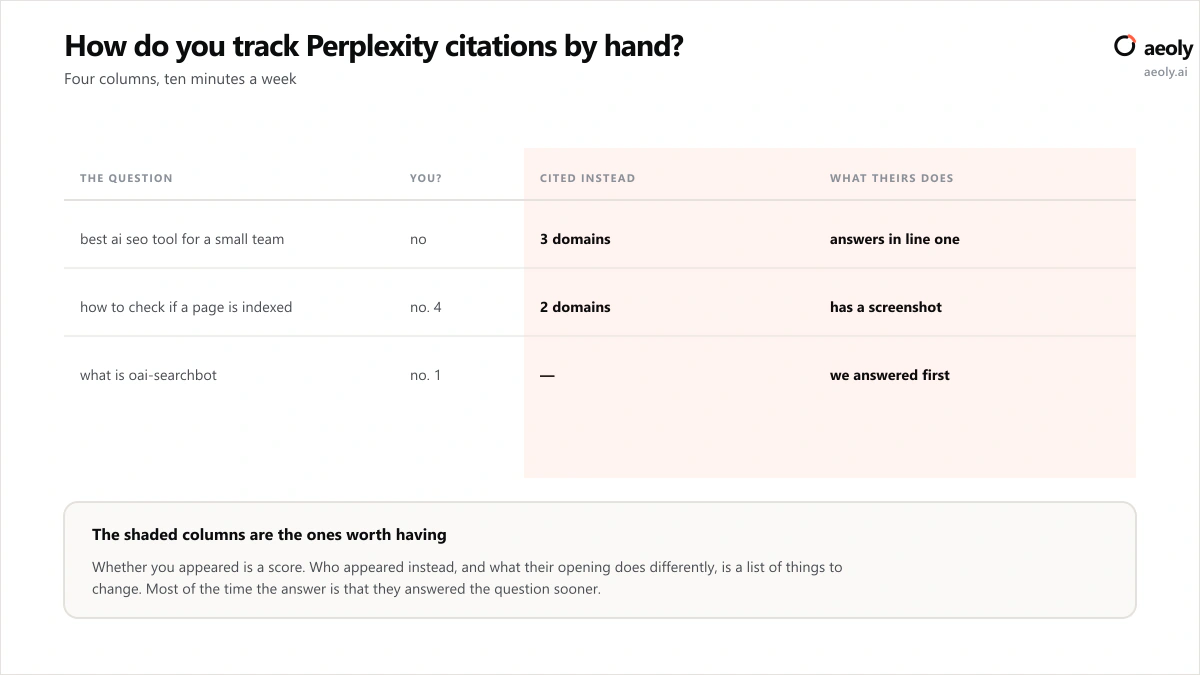
- The question, written exactly as asked, in the buyer's words rather than yours.
- Whether your domain appeared, and at which number.
- Which domains appeared instead. This column is where the actual information is.
- What their page does in its first hundred words that yours does not.
After a month that sheet will tell you something no visibility score can, because it names the pages beating you and shows you what they did. Most of the time the answer is unglamorous: they answered the question sooner.
Why does Perplexity cite competitors instead of me?
If your page says what three other pages already say, there is no reason to prefer it, and the assistant will reach for whichever domain it already trusts. Writing it better does not solve this. Writing something else does.
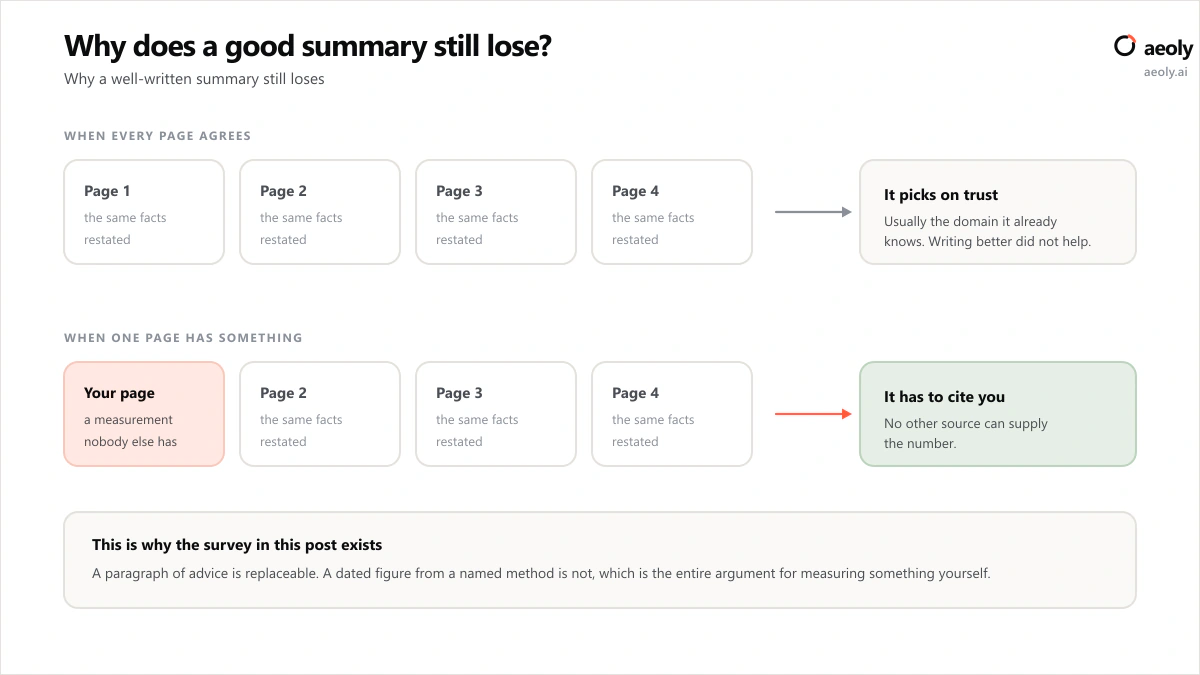
This is the entire reason the survey in this post exists. A paragraph of advice about robots.txt is replaceable by any of a hundred pages. A dated figure produced by a stated method is not, because no other source can supply it.
How do I measure Perplexity citations?
Most AI visibility tools sell a monthly score with no stated method. A defensible measurement looks different: ask the assistant the question a buyer would actually type, with search enabled, record whether your domain is named and which domains were cited instead, and watch the trend across weeks rather than the reading from one run.
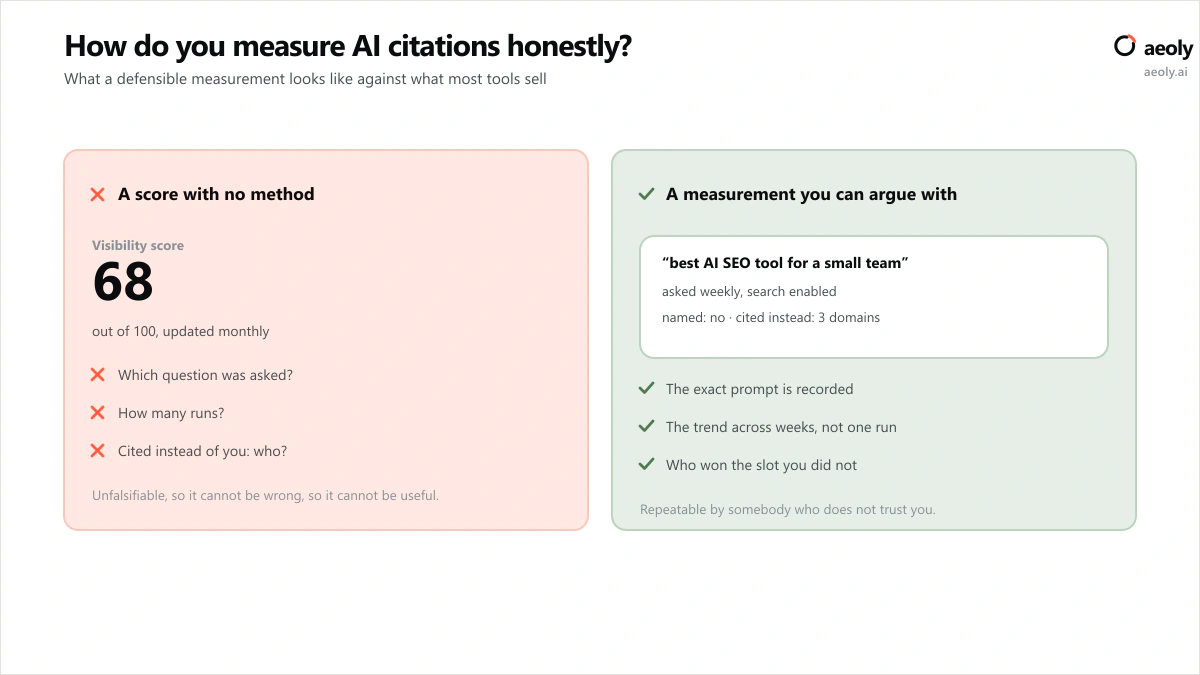
Aeoly does exactly that, and says in the interface that a single check is an anecdote, because a tool that hides its method is asking you to take its word for the one thing you wanted evidence about. You can also do it by hand for free with a spreadsheet and ten minutes a week, which is more than most teams currently do. The automated version is under features.
How to get cited by Perplexity: the short version
Allow PerplexityBot, accept that Perplexity-User will fetch pages regardless, and verify both against the published IP ranges before drawing conclusions from your logs. Then structure pages so the answer sits at the top of the section that promises it, and give the answer a reason to be yours. Getting cited by Perplexity rewards directness more than length, which is a rare thing to be able to say about search.
Anthropic takes the opposite position on user-initiated fetches, which is worth reading next in how to get cited by Claude. The vendor that publishes nothing at all is covered in how to get cited by DeepSeek.
More questions
Does Perplexity ignore robots.txt?
Partly, and it documents which part. PerplexityBot, the crawler that surfaces and links sites in results, respects robots.txt. Perplexity-User, which fetches pages in response to a specific user request, generally ignores robots.txt rules according to Perplexity's own documentation, on the basis that a person initiated the request.
How do I verify a visit really came from Perplexity?
Check the requesting IP against the ranges Perplexity publishes at perplexity.com/perplexitybot.json and perplexity.com/perplexity-user.json. User agent strings can be set to anything by anyone, so a log entry naming PerplexityBot proves nothing on its own.
Does Perplexity use my content for training?
Perplexity's documentation states that PerplexityBot is not used for AI model training and that Perplexity-User is used neither for crawling nor for collecting training data. Both are described as serving search and user requests.
How fast does my page need to be for Perplexity?
Perplexity publishes no threshold, so treat speed as a risk to remove rather than a target to hit. Retrieval happens while a user waits for an answer, and a page that is slow to respond is a page that can be dropped from a set it was otherwise eligible for. The fix is ordinary performance work, not anything AI-specific.
Does Perplexity prefer recent pages?
Perplexity does not publish a freshness rule. What is visible is that dated, maintained pages are easier to trust and easier to quote, and that a page with a stale date on content you have actually kept current is costing you credibility for no reason.
Why does Perplexity cite competitors and not me?
Usually because their page answers the question in its opening lines and yours answers it somewhere in the middle, or because their page carries something yours does not. Compare the two pages on those two axes before concluding anything about authority or backlinks, since both fixes are far cheaper than the reputational one.
Article sources
- PerplexityBot and Perplexity-UserPerplexity documentation
- PerplexityBot IP rangesPerplexity
- AI crawler robots.txt survey, 52 sitesAeoly. Method and site list in scripts/ai-crawler-survey.ts
How to get cited by Perplexity
- How to get cited by Perplexity
- Which Perplexity user agent controls citations?
- How many sites block PerplexityBot?
- What earns a numbered source slot in Perplexity?
- How should I structure a page for Perplexity?
- How do I know if it is working?
- Why does Perplexity cite competitors instead of me?
- How do I measure Perplexity citations?
- How to get cited by Perplexity: the short version